
Search for "Aviator strategy" and you'll find plenty of claims about pattern-spotting, hot streaks, and systems that supposedly beat the game. None of that changes the fact that Aviator runs on an independently audited random number generator: each round's crash point is generated fresh, with no memory of previous rounds. What follows isn't a way to beat the house edge — it's a set of realistic, honest approaches to managing risk and decision-making, the only part of the game actually within a player's control.
Why "Strategy" in Aviator Really Means Risk Management
In games of pure chance with an independent RNG, the term strategy is often misused to imply an edge that doesn't exist. What genuinely differs between a disciplined player and an undisciplined one isn't the outcome of any single round — it's how consistently they manage stake size, cash-out timing, and stopping points across a whole session.
Fixed and Auto Cash-Out Targets
One of the simplest approaches is deciding on a target multiplier before the round starts and sticking to it — always cashing out at 1.3x, or always at 2x, regardless of how the round "feels." Most casinos let you automate this with an auto cash-out setting, which removes the temptation to keep waiting after a promising climb, often where the largest single-round losses happen. It doesn't improve your statistical odds, but it replaces a real-time emotional decision with a pre-committed rule, which many players find easier to stick to under pressure.
Using the Two Bet Panels Deliberately
Because most Aviator interfaces allow two simultaneous stakes per round, some players split a single round's risk into a smaller, lower auto-cash-out bet and a smaller, higher-target bet. This doesn't change the combined expected value versus a single equivalent stake, but it can make a session feel steadier by locking in small wins more often. Treat it as a preference for how variance is distributed, not a way to shift the underlying odds in your favor.
Session Bankroll Sizing
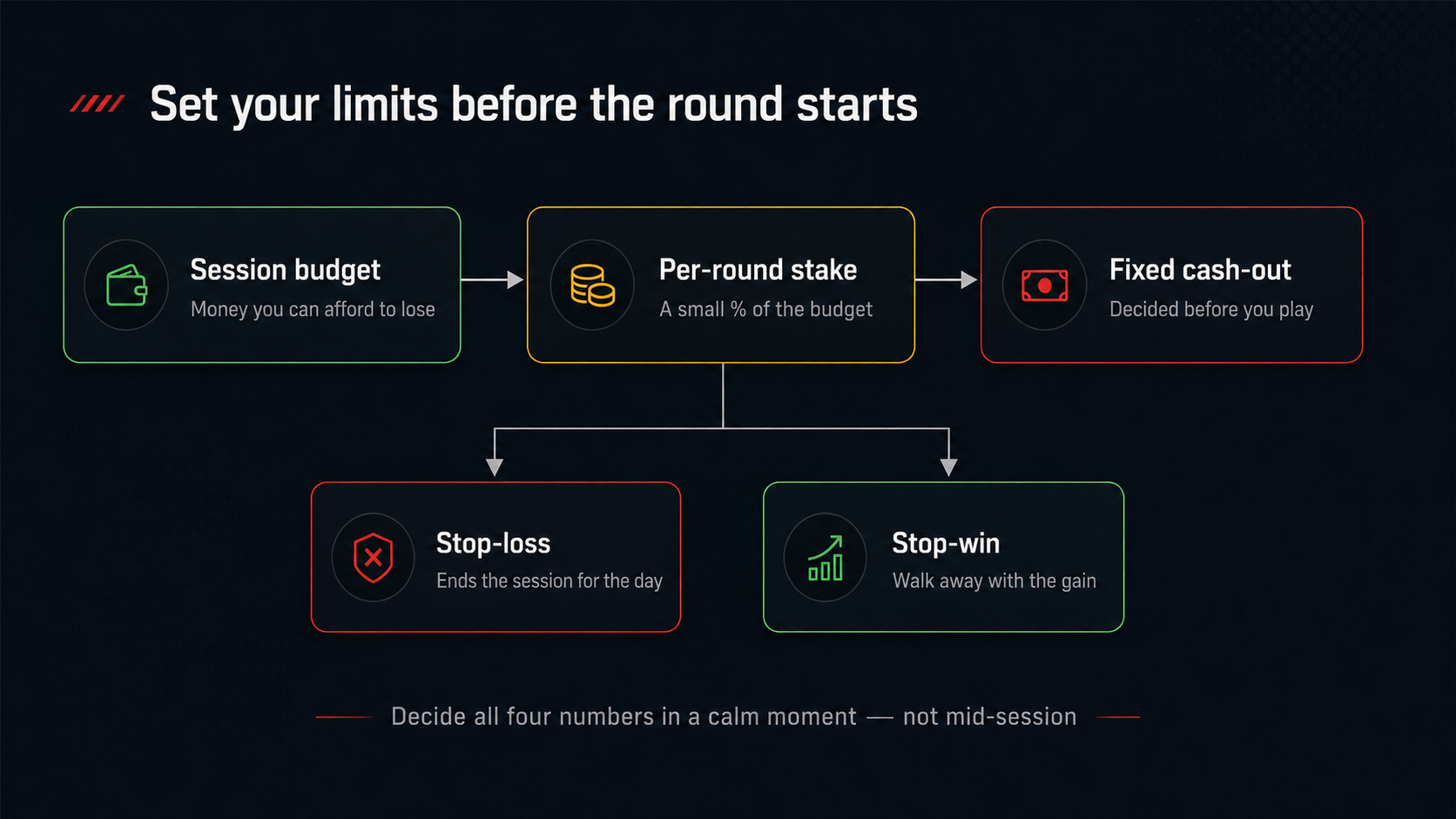
A commonly cited approach among players who track their own play is to set a total entertainment budget for a session in advance — money you are fully prepared to lose — and divide it into a per-round stake that allows a reasonable number of rounds without exhausting the budget on a handful of unlucky flights. There's no universal "correct" percentage; the important part is deciding the number before you start playing.
| Session Budget | Illustrative Per-Round Stake (1-2%) | Approx. Rounds Covered |
|---|---|---|
| ₹1820 | ₹18.20 – ₹36.40 | 50 – 100 |
| ₹4550 | ₹45.50 – ₹91.00 | 50 – 100 |
| ₹9100 | ₹91.00 – ₹182.00 | 50 – 100 |
| ₹18200 | ₹182.00 – ₹364.00 | 50 – 100 |
These figures are purely illustrative arithmetic, not a projection of outcomes.
Setting a Stop-Loss and a Stop-Win
- Stop-loss — a total amount that, once lost in a session, ends play for that day regardless of how the next round "should" go.
- Stop-win — a target gain at which you walk away rather than continuing to push, since sessions commonly give back earlier winnings if play continues indefinitely.
Why Betting Progressions Don't Work Here
Progressive betting systems — doubling a stake after a loss, or increasing it after a win, following patterns like Martingale — are frequently suggested for crash-style games. They don't change the underlying probability of any individual round, and because a plane can fly away at any point, a progression can require an increasingly large stake right as a bankroll is most depleted. These systems redistribute risk; they don't reduce it or create an edge.
Common Bankroll Mistakes to Avoid
- Topping up mid-session — depositing more once the original budget is gone erases the limit that was supposed to define the session.
- Treating winnings as "extra" money to risk — money won during a session is still real money subject to the same house edge.
- Watching the live bet feed instead of your plan — reacting to what other players appear to be cashing out at replaces a plan with a reaction.
- Ignoring session length alongside spend — a budget limit without a time limit can still turn into a much longer session than intended.
Recognizing Problem Gambling Signs
Because Aviator is fast-paced and easy to keep playing "for one more round," it's worth recognizing the difference between entertainment spending and a pattern that's become a problem: spending noticeably more time or money than planned, borrowing money to fund play, lying to people close to you about how much you play, feeling anxious when trying to cut back, and using Aviator to escape stress rather than for enjoyment. Even one or two recurring patterns are worth acting on. Most licensed casinos in India offer self-exclusion and deposit-limit tools directly in account settings, and free, confidential national helplines exist in most regulated markets independent of any casino.
A Realistic Summary
There is no combination of cash-out timing, auto-cashout targets, or staking pattern that overcomes Aviator's built-in house edge over a large number of rounds. The approaches above make sessions more deliberate and less prone to in-the-moment decisions that turn entertainment spending into something bigger than intended — nothing here is a guarantee of profit.