
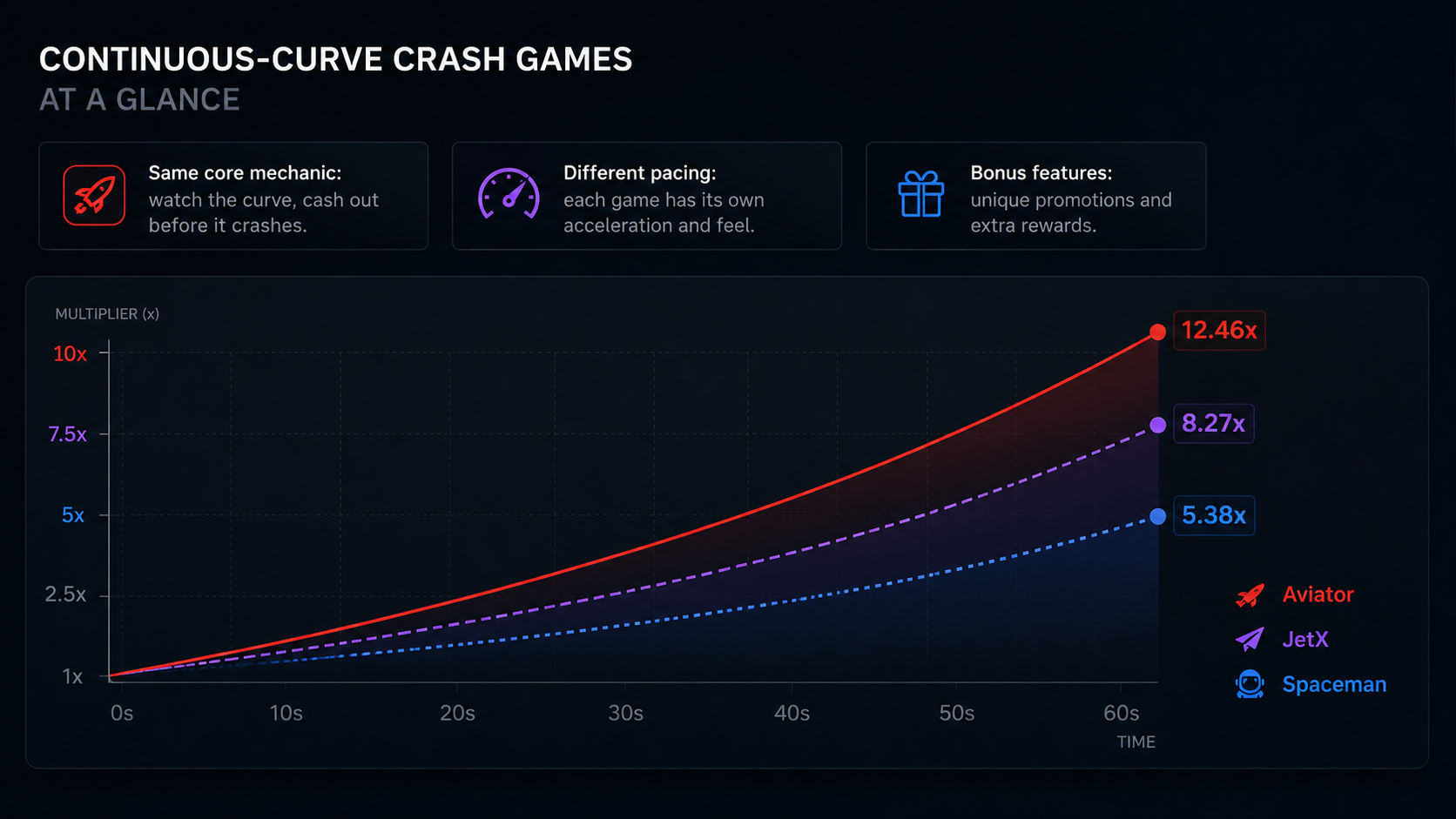
Aviator is the title most credited with taking the crash-game format mainstream in Kenya, but it's now one of several games built around the same core mechanic: a multiplier that grows the longer you stay in, against the risk that the round can end at any moment. What differs between titles is how much visual layering sits on top of that mechanic, how the multiplier moves, and how much control a player feels over the timing of a cash-out. This page compares Aviator with the crash games players most often mention alongside it.
| Game | Progression | Bonus Events | Live Bet Feed | Typical Pacing |
|---|---|---|---|---|
| Aviator | Continuous curve | No | Yes | Fast |
| JetX | Continuous curve | Yes | No | Fast |
| Chicken Road | Discrete hops | No | No | Moderate |
| Aviatrix | Continuous curve | No | Yes | Fast |
| Spaceman | Continuous curve | Yes | No | Fast |
Aviator vs JetX
JetX follows the same continuous-curve format as Aviator but layers in occasional visual bonus events — in-round multiplier boosts tied to the jet passing certain markers. Aviator keeps its interface deliberately minimal, with variance coming purely from the round's crash point rather than any randomized mid-flight boost. Players who prefer a clean, predictable interface tend to gravitate toward Aviator; those who enjoy occasional bonus spikes often prefer JetX.
Aviator vs Chicken Road
Chicken Road reframes the same underlying risk-and-reward idea into discrete, lane-by-lane hops instead of a continuously climbing curve, giving players a distinct decision point after each step rather than a fast-moving number to track in real time. Some players find that pacing calmer; others prefer Aviator's single continuous curve and the ability to cash out at any literal instant rather than waiting for the next discrete hop.
| Feature | Aviator | Chicken Road |
|---|---|---|
| Progression style | Continuous curve | Discrete hops |
| Decision point | Any instant | After each hop |
| Risk customization | Auto cash-out target | Difficulty levels |
Aviator vs Aviatrix
Aviatrix is visually and structurally close to Aviator, also using a live multiplayer feed of other players' cash-out points. The key practical difference tends to be in each platform's specific interface polish and the exact studio behind the RNG — the underlying continuous-curve mechanic and the social feed concept are shared between the two titles.
Aviator vs Spaceman
Spaceman uses the same rising-curve format with a space theme and occasional bonus multiplier events, positioning it closer to JetX than to Aviator's minimal, no-bonus-round design. As with JetX, the choice between Spaceman and Aviator comes down to whether a player wants occasional surprise multiplier spikes or a cleaner, more predictable curve.
Which Style Suits Which Player
- Players who want a clean, fast interface — Aviator's minimal design keeps the focus on one number and one decision.
- Players who enjoy occasional bonus spikes — JetX and Spaceman add randomized in-round multiplier boosts.
- Players who like a pause to think — Chicken Road's per-hop structure suits players who want a beat to decide.
- Players who enjoy social or competitive elements — Aviator and Aviatrix both surface a live feed of other players' cash-outs.
The Common Thread
Whichever title you're drawn to, the fundamental math is the same across the genre: house edge is built in, past rounds don't influence future ones, and no observation of a live feed or recent pattern changes the odds of what happens next. Genre preference in crash games is almost entirely about pacing and presentation, not about finding a title with meaningfully better real odds — differences in RTP between mainstream titles are typically marginal, which the local BCLB monitors closely.
A Brief History of the Crash Game Genre
The crash format traces back to early provably fair crypto-casino experiments, where a simple rising-multiplier curve with a random crash point was easy to build, verify cryptographically, and understand at a glance. Aviator is widely credited with bringing the format to a mainstream casino audience in Kenya at scale after its 2019 release, and its commercial success prompted a wave of similarly structured titles from other studios, each looking for a way to differentiate visually while keeping the mechanic that made the genre popular in the first place.