
Aviator, developed by Spribe and released in 2019, is widely credited with popularizing the "crash" genre of casino games in its current form. A red plane takes off and climbs along a rising curve, with a multiplier increasing in real time for as long as it stays airborne. Players decide when to cash out; wait too long and the plane flies away, ending the round and taking the stake with it. This page is an independent, informational breakdown of how Aviator works and what to weigh up before playing — we do not operate any casino and do not accept wagers ourselves.
How Aviator Works
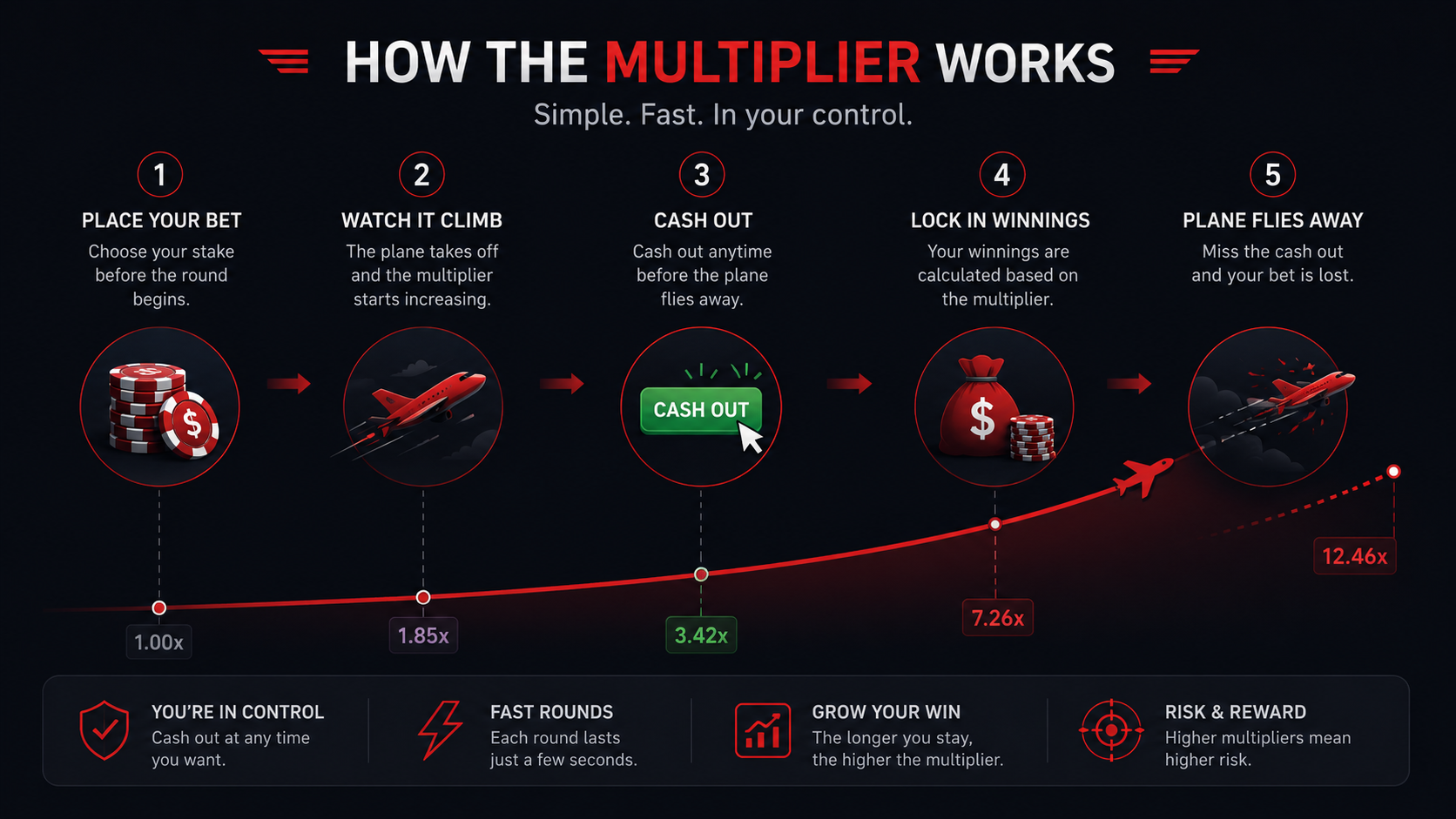
Every player who wants in places a stake — or two stakes, since most casinos allow two simultaneous bets per round — before the plane takes off. Once it launches, the multiplier climbs from 1.00x, and anyone still "in" can tap cash out at any instant to lock in whatever multiplier is showing. The round ends the moment the plane flies off screen at a randomly determined point; anyone who hasn't cashed out by then loses that stake.
A certified random number generator determines the crash point independently for every round, with no memory of previous ones. There is no pattern to detect in a run of low or high rounds — each flight is a fresh, independent event, however it looks on the history bar.
Provable Fairness
Spribe implements a provably fair system for Aviator, letting a player verify after the fact that a round's crash point wasn't altered once bets were placed. This typically combines a server seed — shown as a cryptographic hash before the round starts — with a client seed, so the result can be recalculated and checked afterward. Not every casino surfaces this tool equally clearly, so check a casino's help section for how it documents fairness verification. In South Africa, ensure that the casino is compliant with NGB regulations for fairness.
Understanding RTP and House Edge
RTP (Return to Player) is the theoretical long-run payback percentage of a game, calculated over millions of simulated rounds. Spribe publishes Aviator's baseline RTP at approximately 97%, broadly in line with other crash-style games; the remaining roughly 3% is the house edge. That figure says nothing about your next ten rounds — it describes aggregate behavior across a huge sample. Short-term results swing well above or below it in either direction, which is the entire draw of the game and also why it should be treated as entertainment with real financial risk, not a way to reliably make money.
Key Features That Define Aviator
- Two bet panels — place two independent stakes per round, each with its own cash-out timing.
- Auto bet and auto cash-out — pre-set a repeating stake and a target multiplier to cash out at automatically.
- Live multiplier history — a colour-coded strip of recent round results, useful only as a record, not a forecast.
- Live bet feed — other players' stakes and cash-outs display in real time, adding a social layer.
- Fun/demo mode — a free-play version with virtual credits to test the interface before wagering real money.
None of these features change the underlying odds — they change convenience, timing control, and how much information is visible at a glance.
Where Aviator Fits Among Crash Games
Aviator belongs to a broader family of multiplier-based crash games that also includes JetX, Chicken Road, Aviatrix, and Spaceman. What sets it apart is largely its role as the title that took the format mainstream at scale, plus its minimal interface — no bonus-round animations, just the climbing curve, the cash-out decision, and the live feed. Our comparison page covers how it stacks up against those alternatives in detail.
A Sensible Way to Approach the Game
Because every round's crash point is an independent random event, no staking pattern changes the underlying odds. What matters is treating Aviator as entertainment with a real cost: set a loss limit before you start, decide roughly where you intend to cash out rather than deciding mid-round, and stop once your budget or session time runs out. Our strategies page covers cash-out planning and bankroll thinking in more depth. Players in South Africa should ensure they abide by responsible gaming practices promoted by the NGB.
Where Aviator Is Commonly Available
Aviator is distributed by Spribe to licensed casinos worldwide and has become a flagship title at sportsbook-and-casino platforms including Pin-Up, 1win, 1xBet, Parimatch, and Melbet. Our casinos page rounds up what each operator is generally known for, and our mobile page covers how well each one handles Aviator on a phone.
Glossary & Common Mistakes
- RTP — the theoretical share of wagers a game pays back over a very large number of rounds.
- Crash point — the multiplier at which the plane flies away and the round ends.
- Auto cash-out — a pre-set target multiplier the game cashes out at automatically.
- Treating a hot streak as a signal — a run of high multipliers says nothing about the next round.
- Skipping fun mode — a free demo is a low-cost way to learn the interface before risking real money.
- No stop-loss set in advance — a limit decided after losses start tends to be higher than one set calmly beforehand.